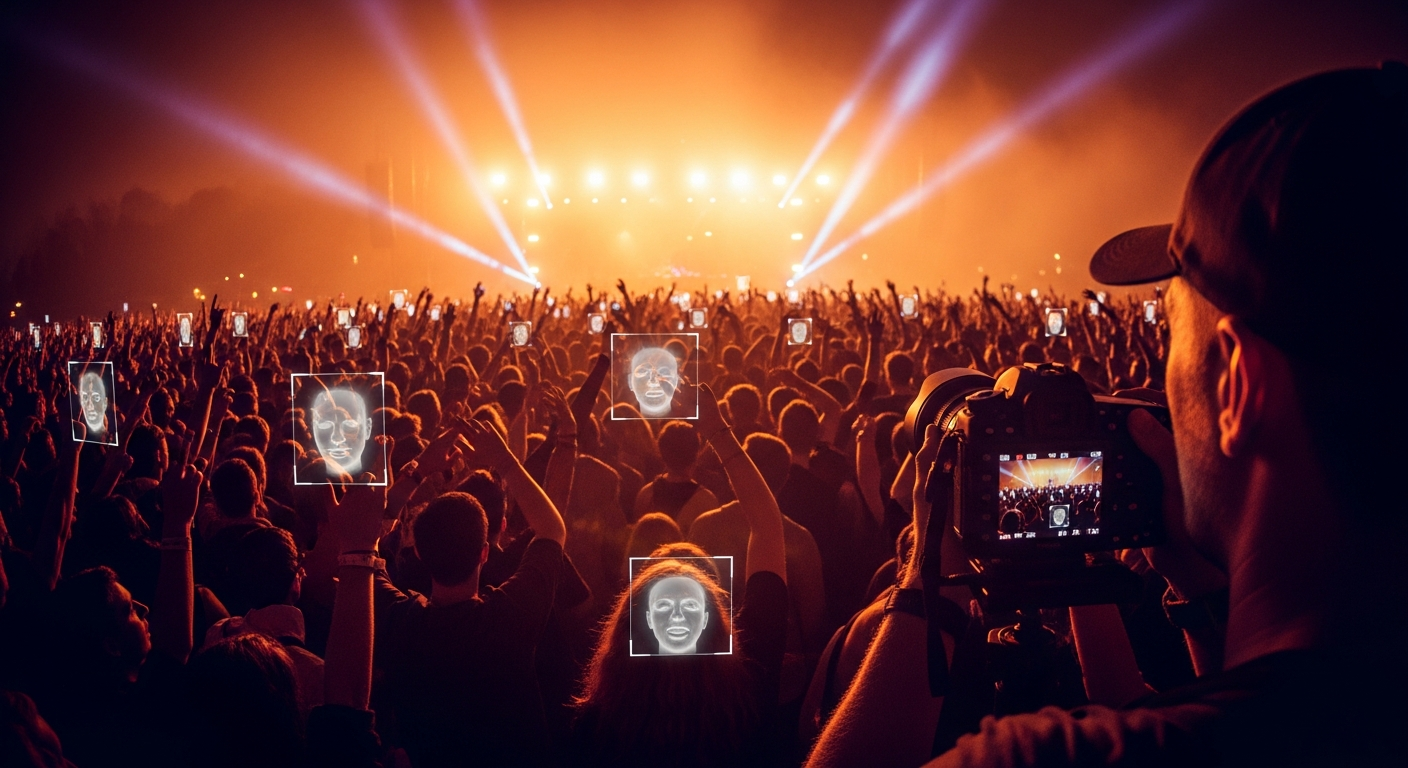
I spent the weekend at a festival in the desert. Four stages, eighteen acts, two changes of clothes, one borrowed cowboy hat. On the bus home Sunday night I did what I always do, which is scroll the official photo team's gallery hoping to find myself in there somewhere. Two hours later, I had found four photos. Three of them were the back of my head.
The next morning I tried the same gallery on a selfie-based matching tool and found twenty-seven photos of me in five seconds. That is the gap this post is about. Not why face matching is faster (it obviously is) but why the manual way ever became the default in the first place, and why the modern way is now genuinely better in almost every dimension.
The default that nobody designed
Nobody sat down and decided that the right way to deliver event photos was a watermarked SmugMug gallery sorted by capture time. It just sort of happened. Photographers wanted a place to dump high volumes of files without paying for individual hosting. Buyers wanted somewhere to scroll. The platforms in the middle made money on photographer subscriptions, not buyer conversion, so nobody had a financial incentive to make finding yourself any easier.
The result is the experience we all know. A gallery of ten thousand thumbnails. Watermarks pulled across every face. A search box that lets you filter by date or maybe by tag, but not by you. You are the unit the entire system is built around, and you are the one thing it cannot help you find.
Why selfie matching changes the economics
The shift is not technological. AWS Rekognition has been available since 2016. The shift is who pays for the friction. In the old model, the buyer pays the friction (in time spent scrolling), and the photographer pays the conversion loss (in buyers who give up). In the new model, the platform absorbs the friction once by indexing faces during upload, and the buyer gets a near-instant result.
Conversion roughly triples when that happens. A buyer who sees twenty-seven photos of themselves does not buy one, they buy a bundle. The math is the part that makes the modern way unavoidable: photographers who switch see real revenue lift, attendees who try the new flow do not go back, and the equilibrium tips. We laid out the operational math in the photographer playbook if you want the spreadsheet version.
What it actually feels like to use
You open the festival photo page. You tap a button that says find my photos. The phone asks for camera permission. You say yes. You take a single selfie in normal light, holding the phone about a foot from your face. While the selfie uploads, the app asks for your email so we can send your matches even if you close the tab.
About three seconds later, you see a grid. Every photo from the festival where the system thinks your face appears, ranked by confidence. The top row is almost certainly you. The bottom row is "we are not sure, take a look." You favorite the ones you love, you buy the ones you want, you order a print of the encore shot if you want something on canvas. That is the whole flow.
The outfit-matching trick
The part that pushed me from "this is good" to "this is the only way I will ever look for festival photos again" was outfit matching. The photographer at the festival took a lot of frames from behind the stage looking out at the crowd. In those frames, you cannot see anyone's face. But you can see jackets, hats, hair colors.
InItPic runs a second pass that looks for the same color blob below a face that did not match well enough on face geometry alone. Then it re-runs face matching on each candidate, so we never accidentally hand you photos of a stranger in a similar jacket. That second pass alone surfaced eight more photos of me, all from the back-of-crowd angle. Three of them are now my favorites from the weekend.
The privacy conversation, briefly
Face matching at events is not the same thing as the dystopian-movie version of facial recognition. The system is asking "is this the same face?" against a single event's photos. It is not asking "who is this face?" against the open internet. There is no name attached to your fingerprint unless you typed one in. The selfie image is deleted after matching unless you opted to save it. You can delete your face data any time. The plain-English breakdown lives on our FAQ, and the deep technical version is in the how the AI works post.
What this means for next weekend
If you have a festival, race, wedding, or concert coming up, ask the photographer whether they are uploading to a selfie-search platform. If they are, you do not have to do anything special at the event. Just have a good time. The matching is on the platform, not on you. Your job at the event is to be in the photos. Their job is to take them. The platform's job is to put the two together.
And if you are looking back at a festival from last summer wondering whether any of those photos are still searchable, the answer depends on the photographer. Galleries that were uploaded to InItPic stay indexed for the life of the event. Take a selfie, point it at the right event, and the matches will still come back.
Try a selfie search yourself
One selfie. Every festival photo of you. Searching is always free.
Find my photos